Welcome to the first post of The Backyard Conservationist. We are kicking things off by tackling a deceptive enemy: the Pompom weed (Campuloclinium macrocephalum).
It may look like a harmless or even attractive “sea of pink” during a Gauteng summer, but behind those fluffy flowers lies a “biological bully” that is effectively ruining our local neighbourhoods.
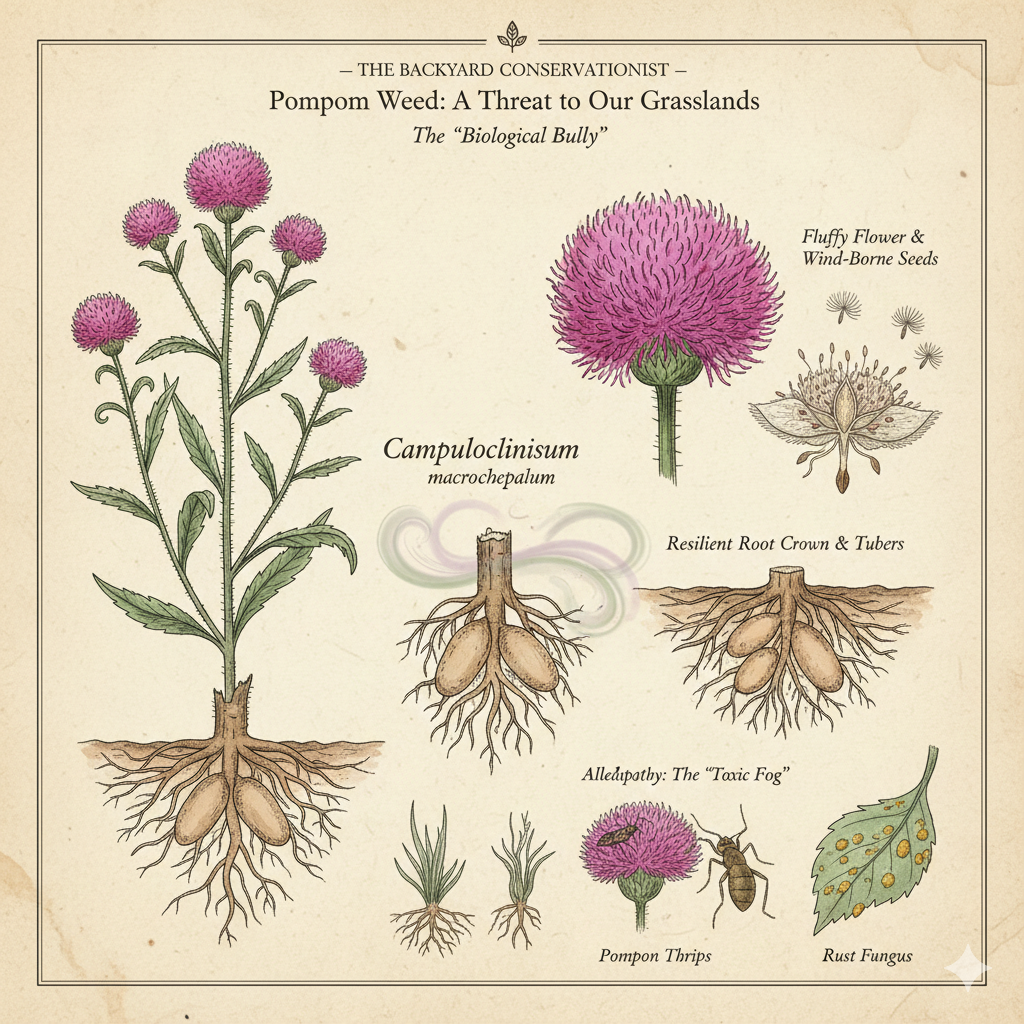
How the bully takes over
Think of the Pompom weed as a neighbour who doesn’t just take the best seat in the house—it releases a “toxic fog” that makes it impossible for the original residents to survive.
- Chemical warfare: The weed uses allelopathy, releasing water-soluble chemicals from its leaves into the soil.
- Suppressing the neighbours: These toxins significantly inhibit the root development and germination of vital, palatable indigenous grasses.
- Physical crowding: It forms dense leaf rosettes at its base, physically blocking native species from growing.
- Hidden strength: While you see the pink flowers, roughly 70% of the plant’s biomass is hidden underground in woody rootstocks and succulent tubers, allowing it to survive frost and fire.
The neighborhood fights back: Groenkloof 2026
The good news is that bullies can be beaten when the community stands together. On February 8, 2026, hundreds of volunteers—including members of ASEZ-WAO and the Friends of Groenkloof and Klapperkop—joined hands at the Groenkloof Nature Reserve.
The team spent the morning cutting and bagging mature flowerheads. This is a critical tactic because each plant produces thousands of seeds that travel on the wind. By removing the flowers before they seed, the community slows the “relentless” spread into undisturbed grasslands.
Read the full article here:
Your defence plan
If you are a homeowner in South Africa, you are more than just a gardener—you are a conservationist. Because Pompom is a Category 1b invasive species, you are legally compelled to control it on your property.
1. Mechanical removal (for small patches)
- Dig Deep: You must remove the plant to below the white root crown.
- Don’t Leave the Tubers: If the crown remains, the plant will simply regrow from its stored underground nutrients.
- Bag the Flowers: If flowers have formed, bag them immediately to prevent wind dispersal.
- No Burning: Never burn dry seeds; the rising heat will actually help disperse them to new areas.
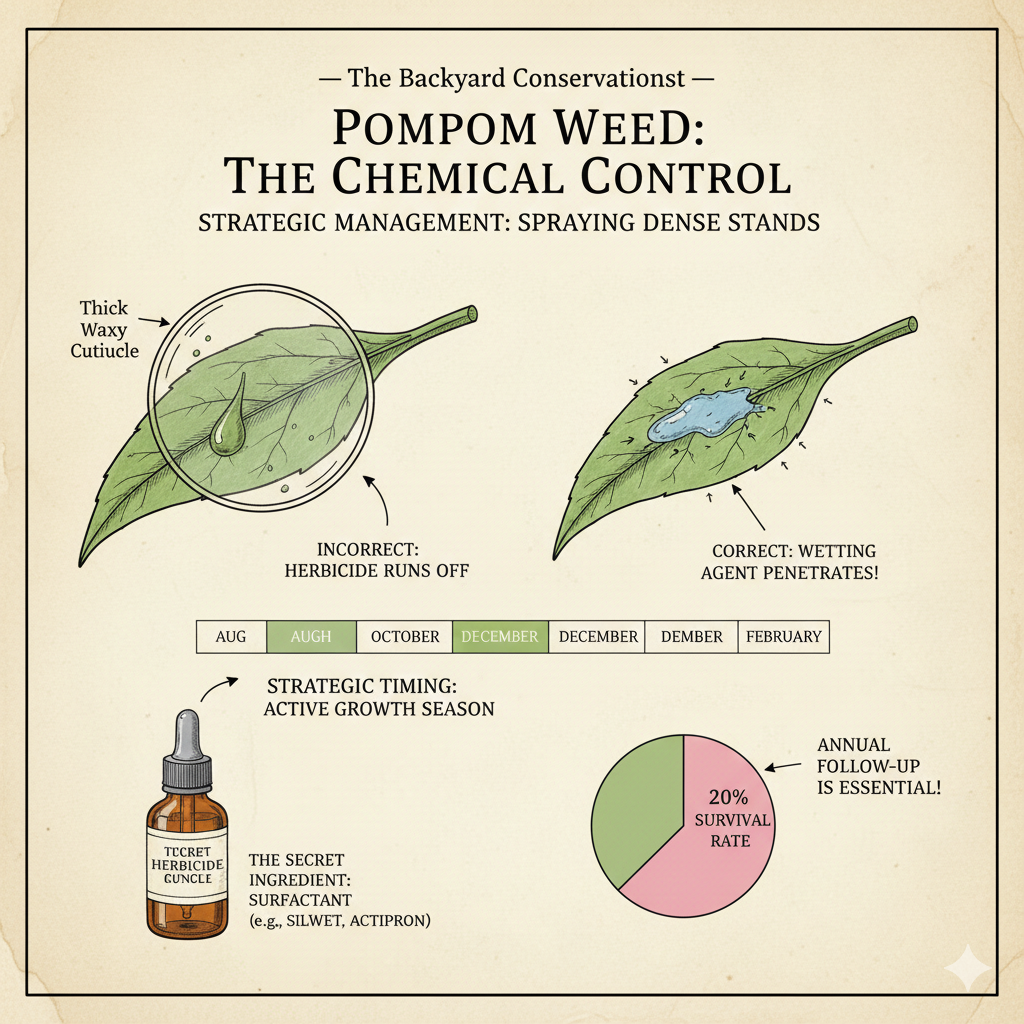
2. Chemical control (for dense stands)
- Timing: Spray during the active growth season, typically between October and December.
- The “Secret” Ingredient: Because the leaves have a thick waxy cuticle, you must use a surfactant or wetting agent (like Silwet or Actipron) or the herbicide won’t penetrate.
- Follow-up: Expect to spray again next year; usually, 20% of the population survives the first round.
3. Biological allies
- Thrips & Fungus: Nature provides its own “security detail.” Insects like Pompom Thrips stunt the plant’s growth, while Rust Fungus yellow and kill off seedlings.

The bottom line
Doing nothing isn’t just bad for the environment; it’s bad for your pocket. Infestations can lead to falling property values and potential legal fines. By removing this bully, you aren’t just weeding – you’re reclaiming the biodiversity of our beautiful South African landscape.
Sources
The following sources provided the scientific research, legislative context, and news reports for this article:
Scientific and field research
- Agricultural Research Council (ARC): Research and imagery regarding pompom weed biology, seedheads, and root structures.+2
- Enviropaedia: Detailed overview of the weed’s threat to South African conservation and agriculture.
- Karin Spottiswoode: “Invasive Alien & Problem Plants on the Witwatersrand and Magaliesberg”.
- Magaliesberg Biosphere: “Sink the Pink” initiative documentation.
- South African National Biodiversity Institute (SANBI): Species profile and classification of the pompom weed.
- University of Pretoria: Research on the allelopathic potential (chemical warfare) of Campuloclinium macrocephalum.
Community and news reports
- ASEZ-WAO (Save the Earth from A to Z): Reports on volunteer environmental clean-up activities in February 2026.
- Friends of Groenkloof and Klapperkop Nature Reserves: Field reports on manual clearing and community mobilization efforts led by Angelique Geeringh.
- Rekord: “Hundreds join hands to tackle invasive pompom weeds in the Groenkloof nature reserve” (Published February 9, 2026).
- SAPIA News / Invasive Species South Africa: Data regarding the spread of invasive species.+1
Legislative and management frameworks
- CARA (Conservation of Agricultural Resources Act): Legal requirements for landowners to control invasive species.
- NEMBA (National Environmental Management: Biodiversity Act): Guidelines and classification for Category 1b prohibited species.

Leave a Reply